Table of Contents
Mirrors #
- Vehicles must be equipped with a minimum of 8 square inches of total usable mirror surface area, provided by one or two mirrors.
- The mirror(s) must provide the driver with a clear view to the rear on both sides of the vehicle. Visibility will be evaluated by the vehicle inspector and race steward using a method they deem appropriate.
- The driver must have a clear and unobstructed view to the front and both sides of the vehicle.
- Electronic sensing devices, including video cameras and monitors, may not be used as a substitute for rearview mirrors.
Safety Belts #
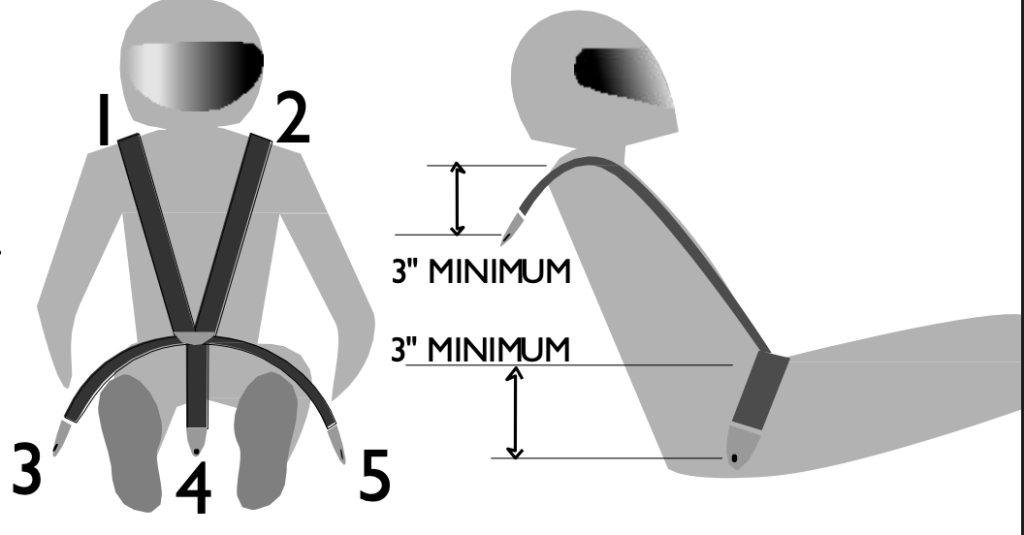
- All vehicles must be equipped with a five-point automotive seat belt system.
- All five belts must be securely attached to the vehicle frame or structural members using mechanical fasteners such as nuts, washers, and bolts. Questionably small fasteners, zip ties, and tape are unacceptable. The harness must be capable of lifting the entire vehicle from the ground with the driver and batteries in place.
- Each waist belt must be mounted to a structural point at least 3 inches below the top of the driver’s waist.
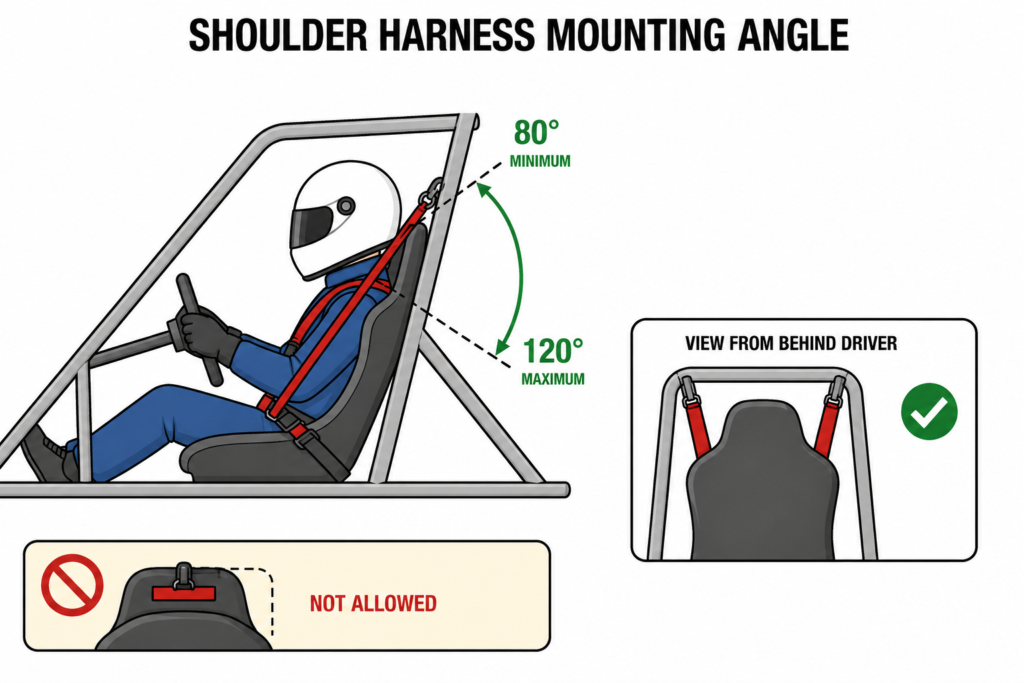
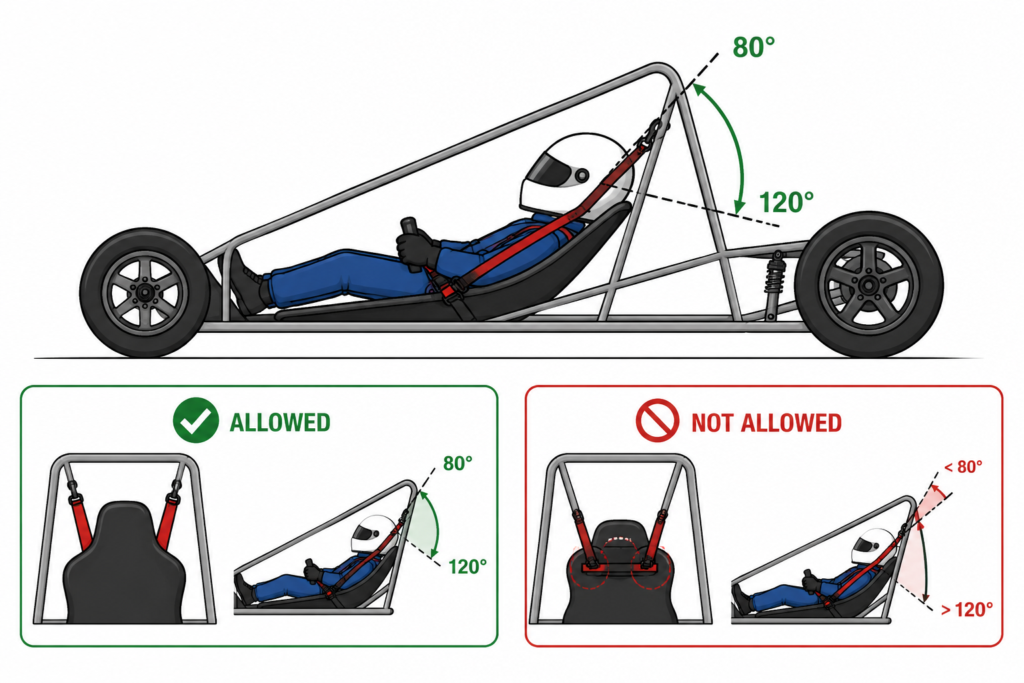
- The shoulder harness must be mounted behind the driver and form an angle of 80 to 120 degrees relative to the seat back, measured at the driver’s shoulder. The shoulder harness must be attached to a structural point at least 3 inches below the driver’s shoulder and must be installed without interference from the seat or other items. The seat itself, or anything added only to the seat, shall not be considered a suitable guide. Guides must be part of the roll cage or vehicle structure.
- The seat belt, shoulder harness, and crotch strap must secure the driver in a position that prevents excessive movement. The shoulder harness must be installed so that it cannot slip off the driver’s shoulders while driving. In the event of a sudden stop, the restraint system must prevent the driver from sliding forward and maintain the driver’s shoulders in the driving position. The seat belt system must securely restrain the driver in the event of a vehicle rollover.
Driving Position #
- Drivers must operate the vehicle in a seated or recumbent (reclining) position. Kneeling and prone (head-first) driving positions are prohibited.
- The driver’s arms and legs must remain within the vehicle body structure while the vehicle is in competition.
Driver Protective Equipment #
HELMETS
- All drivers must wear a DOT-approved, full-face, hard-shell helmet during competition. Bicycle and skateboard helmets are not permitted.
- The helmet chin strap must be properly and securely fastened whenever the vehicle is in operation.
DRIVER ATTIRE
- Drivers must be fully clothed during competition.
- Long-sleeve shirts, long pants, and closed-toe shoes are required. Water socks and wrestling shoes are acceptable.
- Gloves are required for open-cockpit vehicles and optional for enclosed-canopy vehicles. Fingerless gloves are permitted.
- All drivers must wear eye protection while operating an Electrathon vehicle. Acceptable eye protection includes Z87-rated safety glasses, goggles, or a full-face shield integrated into the helmet.
- Long hair must be securely contained so that it cannot reach the drivetrain.
- Necklaces, wrist and ankle bracelets, and large earrings must be removed before operating the vehicle.
Cell Phones/Communication Devices #
- Push-to-talk radios are permitted provided the driver can operate them without being distracted from safely operating the vehicle.
- Cell phones may be used while the vehicle is in motion only for hands-free communication on an open call. The call must be initiated while the vehicle is stopped and the driver must not hold or manually operate the phone while driving. Hands-free communication should be connected through a Bluetooth-enabled helmet or other hands-free device.
- Dialing, answering, texting, or manually operating a cell phone while the vehicle is in motion is prohibited. A cell phone may be used manually when the vehicle is stopped.
- Texting is prohibited whenever the driver is physically in the vehicle.
- Violation of Rules 2 or 3 will result in the immediate disqualification of the driver and vehicle.
- After two violations of Rules 2 or 3 during the same calendar year, the driver will be prohibited from using any electronic communication device while competing for the remainder of the year.
Exiting the Vehicle #
- The driver must be able to exit the vehicle without assistance within 20 seconds while the vehicle is configured as it is during competition. This includes releasing or removing any external method used to secure a canopy.
- Drivers with disabilities may be permitted up to 2 minutes to exit the vehicle with assistance, subject to approval by the event steward.


